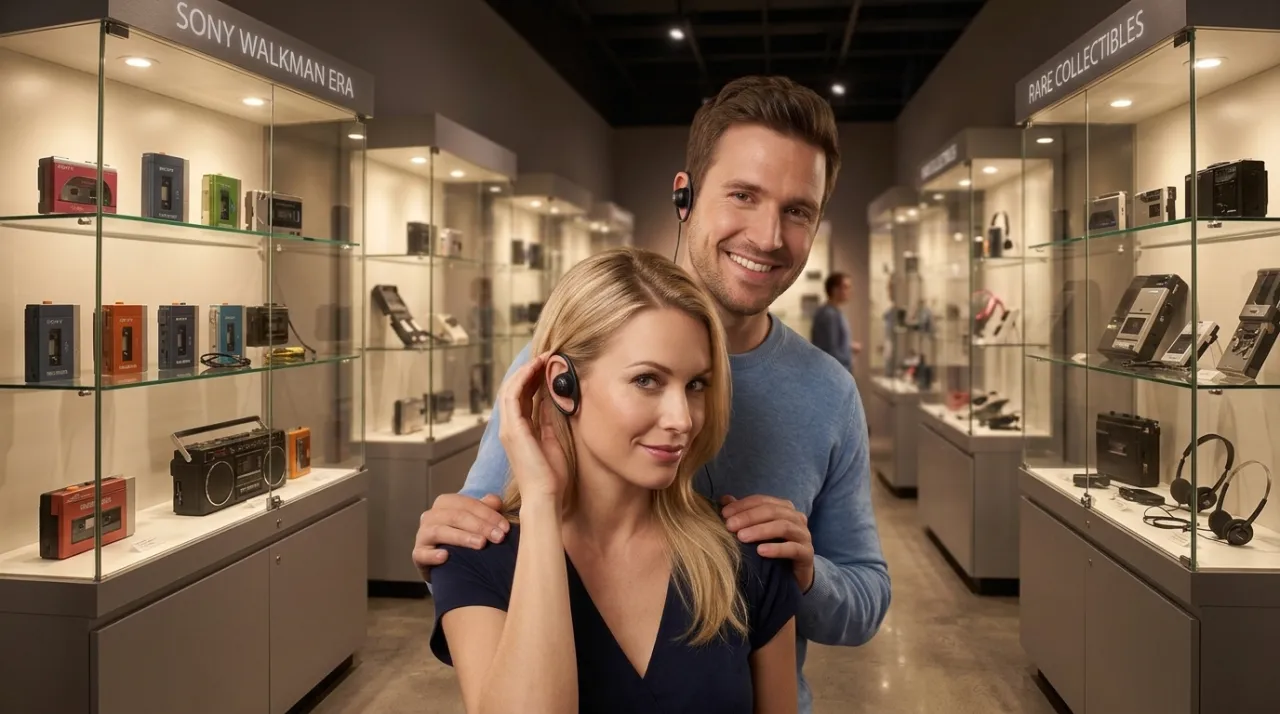
When people search for museum earphones, they rarely mean a simple pair of earbuds. In most cases, they mean the gear that guides visitors through a museum, such as an audio guide or a tour guide system. Yet there are far more options than most museums think. A guide can speak live, but a story can also come pre-recorded. In addition, visitors can use their own smartphone. In this article, we list every option for museum earphones. That way, you can quickly see which solution suits your collection, your visitors and your budget.
What do we mean by museum earphones?
In a museum, the word earphones covers two things. First, the device that delivers the sound. That can be an audio guide, a multimedia guide or a receiver for a guided tour. Second, the earphone or headset itself: the part the visitor wears on or near the ear. Both choices go hand in hand, because the best museum earphones come from the right mix of device and earpiece. After all, a good story only works when it sounds clear and the earpiece feels comfortable.
So we look at the systems first, and then at the earphones. We split the systems into four groups:
- Live: a guide speaks and the group listens through a tour guide system.
- Pre-recorded: visitors pick a story themselves on an audio guide or multimedia guide.
- Hybrid: one device for both individual visitors and groups with a guide.
- BYOD: visitors use their own phone and their own earphones.
Live: earphones with a tour guide system
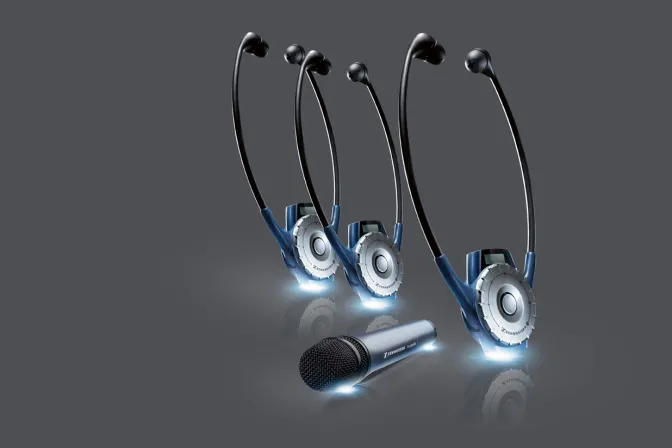
On a group tour, you want everyone to hear the guide clearly. That includes the people at the back, and it includes busy rooms. A tour guide system solves this. The guide talks softly into a small transmitter. Each guest wears a light receiver with earphones and hears the guide as if they stood right next to them. So the guide never has to shout, and other visitors in the museum hear nothing of it.
We rent out the Sennheiser Tourguide 2020-D. Its receiver is a stethoset: a light frame with two earpieces that hangs under the chin. There is also a version with headphones. One battery lasts up to 16 hours, so a full day of tours is no problem. Thanks to six channels, several groups can also walk through the building at the same time. This tour guide system is also known as a whisper set. Want to know more? Then read what a whisper set is.
Pre-recorded: the Orpheo Mikro audio guide
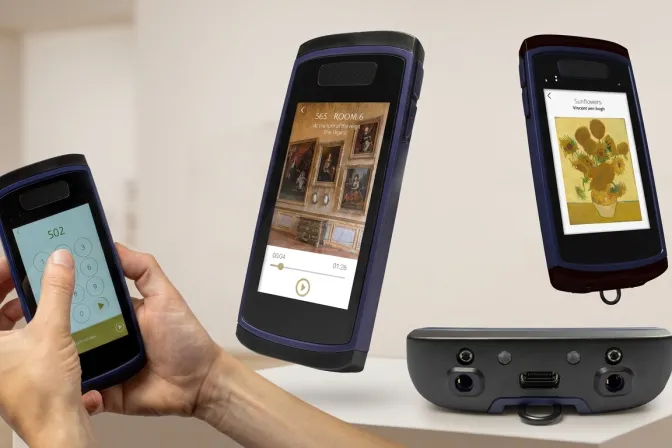
Not every visitor wants to join a group. Many people prefer to explore at their own pace. For them, an audio guide is ideal. Visitors type in the number next to an object and hear the story right away, in their own language. For more than thirty years, the Orpheo Mikro has been a trusted choice for this.
This device is small, light and sturdy. It can take a knock, and the battery lasts more than 18 hours. If you like, the story also starts on its own via infrared as soon as a visitor walks into a room. The device has two sockets for earphones. As a result, two people can share one audio guide. For couples and for parents with a child, two sets of museum earphones on one device are a real plus. The Mikro also works with a hearing loop for people who are hard of hearing.

Multimedia in your hand: the Orpheo Touch
Sometimes a picture says more than words. Think of a model of a lost building, or a video about a restoration. In that case, you choose a multimedia guide such as the Orpheo Touch. It has a large 6.4-inch screen and feels like a smartphone. Even so, it can handle heavy daily use in a museum.
On the Touch, you combine audio with text, photos, video, a 3D map and even augmented reality. There are also three ways to listen: an earpiece, the built-in speaker or two sockets for headphones. Indoors, an earpiece is often the best choice, because it is discreet and personal. Outdoors, on the other hand, the speaker works well.
The Orpheo Hybe Tour: images, sound and video
The Orpheo Hybe is the newest generation of guide from Orpheo. You choose a model with a large touchscreen or one with a keypad. In the Hybe Tour version, it suits visitors who explore on their own. Just like with an audio guide, they pick a story, but now with images and video. Sign language is also possible, and the story can start on its own via infrared.
The Hybe is waterproof to IP64, so it can go outside too. Moreover, its battery lasts up to 20 hours, which keeps the earphones in use for a whole museum day. The device has two earphone sockets plus a speaker. That makes the Hybe Tour a fit for a museum, but also for a castle garden or an outdoor site.

Hybrid: museum earphones for groups with the Orpheo Hybe Live
Many museums have two kinds of visitors. During the day, individual visitors walk around, but school classes and guided groups come too. Usually, that means you need two systems. With the Orpheo Hybe Live, one device is enough. It is a multimedia guide and a tour guide system in one.
On a tour, the guide speaks into the transmitter, and the group hears them through their own earphones. A group can have up to 1024 visitors, with a range of up to 100 metres in open space. The guide can also start images or videos on all devices at once. In addition, visitors can ask a question via push to talk. Read more in Orpheo Hybe Live: tour guide system with multimedia.
BYOD: their own earphones and smartphone in the museum
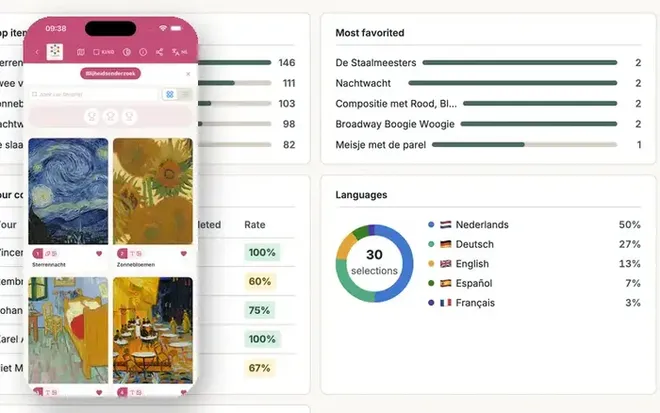
Almost every visitor carries a smartphone, and often their own earphones too. That is the idea behind BYOD, or Bring Your Own Device. The museum then has no devices to hand out, charge or clean. Visitors scan a QR code and start listening right away, with their own earphones in.
For this, we built infotainment.guide, a museum app that runs in the browser. So there is no download from the App Store. Besides audio, the app offers photos, video, games and separate tours for children. It also works offline, for example in a cellar with no signal. Read more in the interactive museum app for young and old.
Still, BYOD does not fit every case. Not every visitor brings earphones, and not everyone wants to use their own phone. That is why many museums choose a mix: the app for those who want it, and an audio guide for everyone else. Why that works well is explained in a museum app as an audio guide alongside hardware.
Which earphones does the museum hand out?
Do you choose an audio guide or a multimedia guide? Then you also give visitors something to listen with. Here, you have two main options: a headset on the head or a single earpiece on one ear. Both fit any device with a standard 3.5 mm socket.
The Orpheo Airset is an open headset without ear pads. It never touches the ear, yet it sends the sound straight to it. As a result, visitors still hear their surroundings and can talk to each other. At 95 grams, it is very light. It also works well with hearing aids, and with an extra part it fits a child's head. You order the Airset in sets of ten.
The Mono earphone from Orpheo is even simpler. It is a single earpiece with a hook that rests around the ear. The other ear stays free. That helps when visitors also want to hear a guard, a guide or their friends. The earphone has a gold-plated 3.5 mm plug and a 90 cm cord.
Keeping museum earphones clean
Hygiene matters a lot for earphones that pass from visitor to visitor in a museum. Foam and soft pads soak up sweat and dirt. What's more, you can never get them fully clean. Many museums therefore use throwaway covers, but those cost money and create waste.
That is why more and more museums choose earphones made of smooth plastic. The Airset has no foam, so you wipe it clean in one go after each visit. The Mono earphone is quick to clean as well. With BYOD, this problem does not even exist, because every visitor uses their own earphones. Read more about this topic in headphones without ear pads.
Which earphones suit your museum?
There are no earphones that are the best choice for every museum. However, a few questions help you decide:
- Do you mostly work with guides and groups? Then a tour guide system is the logical step.
- Do visitors prefer to explore alone? Then choose an audio guide such as the Orpheo Mikro.
- Do you also want to show images and video? Then the Orpheo Touch or the Orpheo Hybe Tour fits.
- Do you have both individual visitors and groups? The Orpheo Hybe Live does both with one device.
- Would you rather not manage any devices? Then infotainment.guide on the visitor's own phone is a smart choice.
Of course, you can also combine them. A museum often uses an audio guide for individual visitors and a tour guide system for groups. On top of that, the museum app can add to the offer for those who prefer their own phone. Still unsure about the right headset? Then also read which headphones suit your attraction best.
Advice on earphones for your museum
In short, museum earphones are much more than a cord with an earbud. It is about the whole experience: how visitors hear, see and remember the story. For years, GuideXpresse has helped museums, castles and visitor centres make this choice. We rent out the tour guide system, and we supply the audio guide, the multimedia guide and the earphones. What's more, we know the museum app inside out, because we built it ourselves.
Would you like to know which solution suits your museum? and we will gladly help you choose.
Disclaimer: the hero photo in this article was made with AI. The products in the photos are, of course, real.
Updated on
Stay up to date
Every now and then, the news from GuideXpresse in a single email: museum guides, tour guide systems, software, service and voice-overs. Short and no more often than needed.


 References