Do you know that irritation when the sound and picture of a TV programme are out of sync? The same applies in a museum or exhibition with video screens. With audio guides that play in sync with the video, visitors hear the sound in their own language, at exactly the right moment. In this article you can read how that works.
The sound in the audio guide, not in the room
With a video in an exhibition, the sound traditionally comes from speakers in the room, in a single language. With Orpheo audio guides, you move the sound to the visitor's guide. Visitors do not have to take off their headphones at a screen, they hear the sound in their own language and the room stays quiet. That keeps the flow of the visit intact.
Timecodes keep audio guides in sync with video
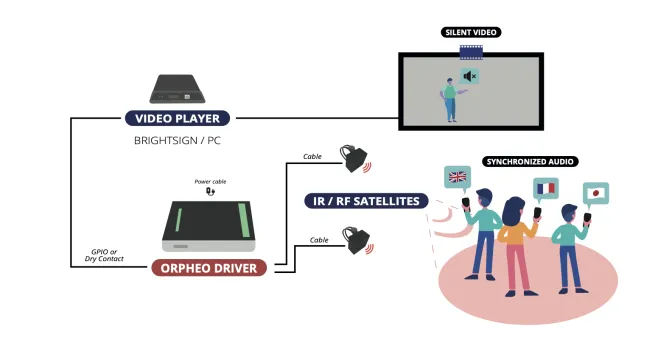
The technology behind it is simple and reliable: the video sends out timecodes and the audio guide starts the sound at exactly the right moment. If a visitor walks in halfway through the film, the audio guide joins in at the right point. So there is no hassle waiting for the film to start again. In this way, the audio guides stay in sync with the video for every visitor, in every language.
How audio guides stay in sync with video
At the heart of the system is the Orpheo Driver, a small box of eleven by eleven centimetres. The video player connects to the Driver with a cable. That can be a BrightSign player, but also a PC or another media player. It then passes on the start signal via GPIO or a dry contact.
Next, the Driver sends the signal to up to four satellites. These are small transmitters on the wall or ceiling that pass it on wirelessly to the audio guides. For a larger space, you simply connect several Drivers in series.
An important difference from streaming: the sound itself never travels through the air. The audio is already stored on the audio guide and the satellite only sends the timecode. As a result, the audio guides stay in sync with the video down to the frame, without dropouts or the delay of a wireless network. The video itself plays silently.
Infrared or radio frequency
For each room, you then choose the satellite that fits best:
- Infrared (IR): a range of up to 40 metres in open space and a beam of 34 degrees. Ideal when the sound should only start for visitors standing in front of the screen.
- Radio frequency (RF): a range of 4 to 100 metres in open space. Suitable for large halls or a projection that visitors see from several places. However, this requires RF-compatible audio guides.
With both, you can fine-tune the range on site with a small dial, so the signal does not spill into the next room. Moreover, the satellites measure about four centimetres, weigh 38 grams and hang on an adjustable bracket. With the optional case, they are also splash-proof (IP54).
The Orpheo Mikro LX
The Orpheo Mikro LX is ideally suited to this. It starts stories automatically via infrared, delivers high sound quality and supports as many languages as you need. With two headphone sockets and a built-in speaker, it is also suitable for visitors with a hearing or visual impairment.

Audio guides in sync with video in practice
At several Dutch venues, the Orpheo audio guides play in sync with the picture at certain spots, which increases visitor satisfaction:
The technology is also used internationally, for example for the documentaries on Ellis Island in New York. Read about it in The hybrid media guide of the Statue of Liberty.
For temporary exhibitions too
Audio guides in sync with video are particularly interesting for temporary exhibitions: no speakers need to be installed in the room and adding a new language is easy. If you wish, you can also rent the audio guides for the duration of the exhibition.
You will find all technical specifications of the Orpheo Driver and the satellites in the brochure below.
Related brochures
-
 Orpheo Driver: audio/video synchronisation
Download
Updated on
Stay up to date
Every now and then, the news from GuideXpresse in a single email: museum guides, tour guide systems, software, service and voice-overs. Short and no more often than needed.

 References