The length of an audio story largely determines whether visitors stay captivated. Too short feels superficial, too long becomes boring. In this article we set out what research and practice say about the ideal length of audio stories in an audio guide, and how to use layers of depth without making the core story longer.
Why does the length of an audio story matter so much?
Audio stories are the heart of an audio tour. They tell visitors about art, history or the place where they are standing. Visitors, however, have limited time and energy. In a museum there are many visual stimuli; outdoors, the weather plays a part too. A story that goes on too long increases the chance that the listener drops out.
With an audio guide, visitors can pause, but a good length keeps them engaged by itself. That improves satisfaction with the tour as a whole.
What does research say about the optimal length?
Various sources give the same guideline: keep an audio clip under two minutes. That is roughly 130 to 260 words. Listeners are usually standing and their attention is limited. A frequently cited ideal length is 60 to 90 seconds: enough for a rounded story, short enough to hold attention. For an in-depth story, two minutes can work.
An evaluation by the Metropolitan Museum found that shorter clips go down better: visitors used only a small part of the long guides. The lesson: bundle and simplify.
A different measure applies to the tour as a whole. A museum tour often lasts 20 to 60 minutes, spread over several stops. For a walking tour, 45 to 60 minutes is a good length. Per story, 1 to 3 minutes remains the common denominator.

Factors that influence the ideal length
No two audio tours are the same. These factors play a part:
- The audience: children are more easily distracted than adults. Tailor the length to your target group, if necessary with a separate children's version.
- The location: in a museum, visitors stop at an object; outdoors, people walk more loosely. Outdoors, shorter clips work better, for example one minute per point.
- The subject: simple facts are told briefly. Split complex stories into parts, but never go over five minutes per clip.
- The technology: automatic triggering at an object or zone invites short clips.
- The language: speaking pace differs per language. English is generally spoken faster than Dutch.
- Interactivity: with a quiz or images on a (hybrid) multimedia guide, you can break up a longer story.
Tips for making good audio stories
Start with a script. Count on about 130 words per minute. No experience with scripts? GuideXpresse is happy to put you in touch with a good scriptwriter.
Work in a structured way: a catchy opening, then the facts and finally a prompt. For example: "Now look at the painting on your left" or "In two minutes you will reach the restaurant for a cup of coffee." Vary the speaking pace and add sound effects if you like, but don't overdo it: the content comes first.
Always test. Let test listeners hear it, collect their feedback and adjust the length where necessary. Also make stops recognisable, for example with an image on the screen of the Orpheo Mikro.
Layers of depth for more flexibility
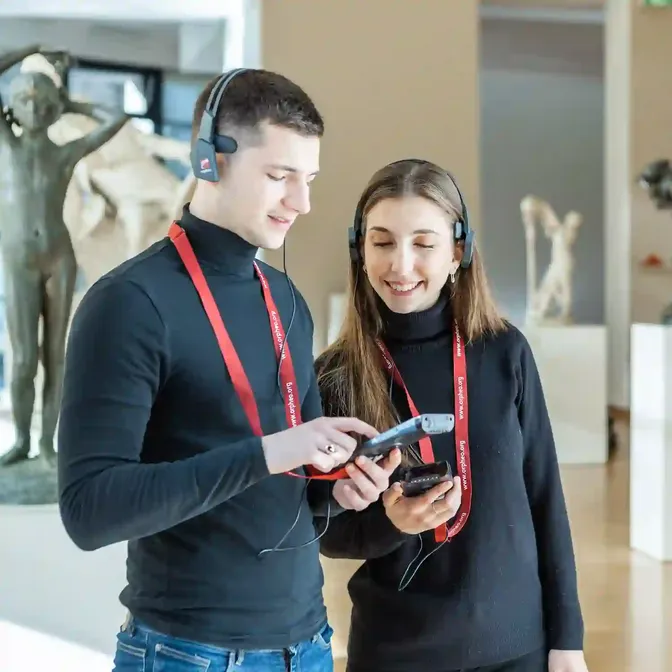
A smart way to keep the core story short is to build in layers of depth. The Orpheo Mikro audio guide has three coloured buttons (red, yellow and green) that start an extra layer of content. End the short story with something like: "Would you like to know more about this painting? Then press the green button."
That keeps the average length short, while interested listeners can dig deeper. The green button might tell an anecdote, the yellow one a related fact and the red one a different perspective. Visitors choose for themselves how deep they go. Do make sure the base layer is complete in itself: depth is optional. In GuideXpresse Manager you can easily link the buttons to the right clips.
Examples from practice
The British Museum offers tours of about an hour, made up of short, themed stories. Self-guided city tours, such as in Berlin, often consist of dozens of stories averaging one to two minutes. And accessible audio guides in Flemish museums deliberately keep their clips short, so that visitors with a disability can follow them easily too.
Conclusion: find your optimal length
The best length for an audio story in an audio guide is one to two minutes per clip, within a tour of 20 to 60 minutes in total. With layers of depth, you give interested visitors more without tiring the rest.
Below you can hear an example of one of the voices you can find and book through GuideXpresse.
Sources
Updated on
Stay up to date
Every now and then, the news from GuideXpresse in a single email: museum guides, tour guide systems, software, service and voice-overs. Short and no more often than needed.

 References